Case
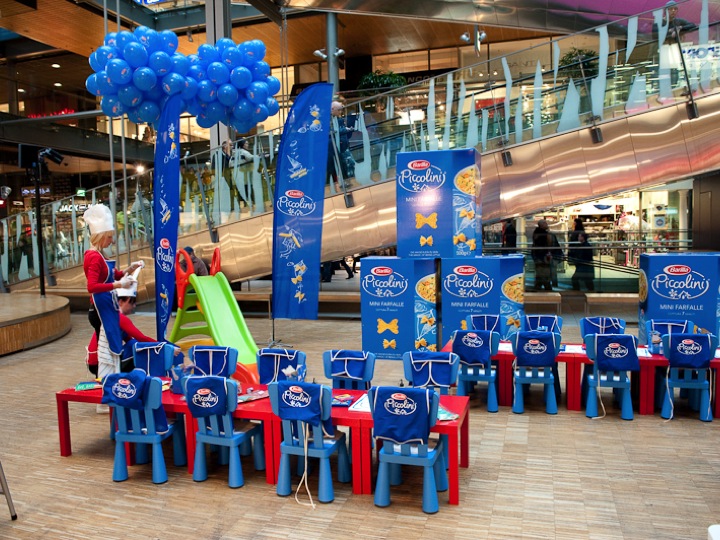
The Barilla Piccolini campaign was built entirely around the family shopper. Piccolini is Barilla's small-format pasta designed specifically for families — so the campaign had to be more than a sample pack. Fridays delivered experiential promotion units in shopping centres where a family Sunday was turned into a pasta-cooking, tasting, and activity-driven encounter.
At the centre of the setup was a tasting station where a promoter cooked Piccolini portions on the spot and served them to visitors. Next to it stood a kids' activity area where children could try decorating their own pasta, play pasta-themed games, or simply meet the ingredients. That activity was decisive: when the child is engaged, the parent stays — and that is exactly the moment when the promoter can have a proper qualitative conversation about the product without rush.
Fridays owned the delivery from concept to production: booth design and materials, food-handling permits, promoter recruitment and training, tour scheduling with the shopping centres, and daily reporting to the client. Food promotion requires specialist expertise: hygiene, storage temperatures, allergen information, and occupational safety are all areas where shortcuts don't exist.
The campaign had three objectives: reaching family audiences — Piccolini's buyer is typically a parent thinking about what to serve their children; tastings and trials — when the product hits the taste buds in the store aisle, buying intent rises significantly; and strong shopping-centre visibility — a branded unit in the middle of a lobby is a visual message to the tens of thousands of visitors who pass by without stopping.
All three landed. The campaign produced tens of thousands of tastings, wide family participation, and measurable shopping-centre visibility. Fridays proved that commercialising an FMCG product in a shopping centre is a story, not a product sample — and that the story is built from real activity, not a slogan.
Fridays' delivery model on activations of this scale rests on four cornerstones. Recruitment and employment run entirely through us, so no shift ever leaves the client carrying employer risk. Briefing and training are done before every shift so brand look, key messages, and behavioural rules land with each individual worker. On-site coordination runs through a named shift lead who stays in contact with the client's producer across the day and reacts to changing situations before they turn into problems. Daily reporting turns encounters, feedback, and observations into a document that can be walked straight into the next planning meeting. This chain is built over years and is the reason clients come back to the same activations year after year — we sell an operating model, not individual workers.
Tulokset
Valmiina parempiin kohtaamisiin?
Kerro meille tavoitteesi ja tehdään yhdessä kampanja joka tuottaa tulosta.